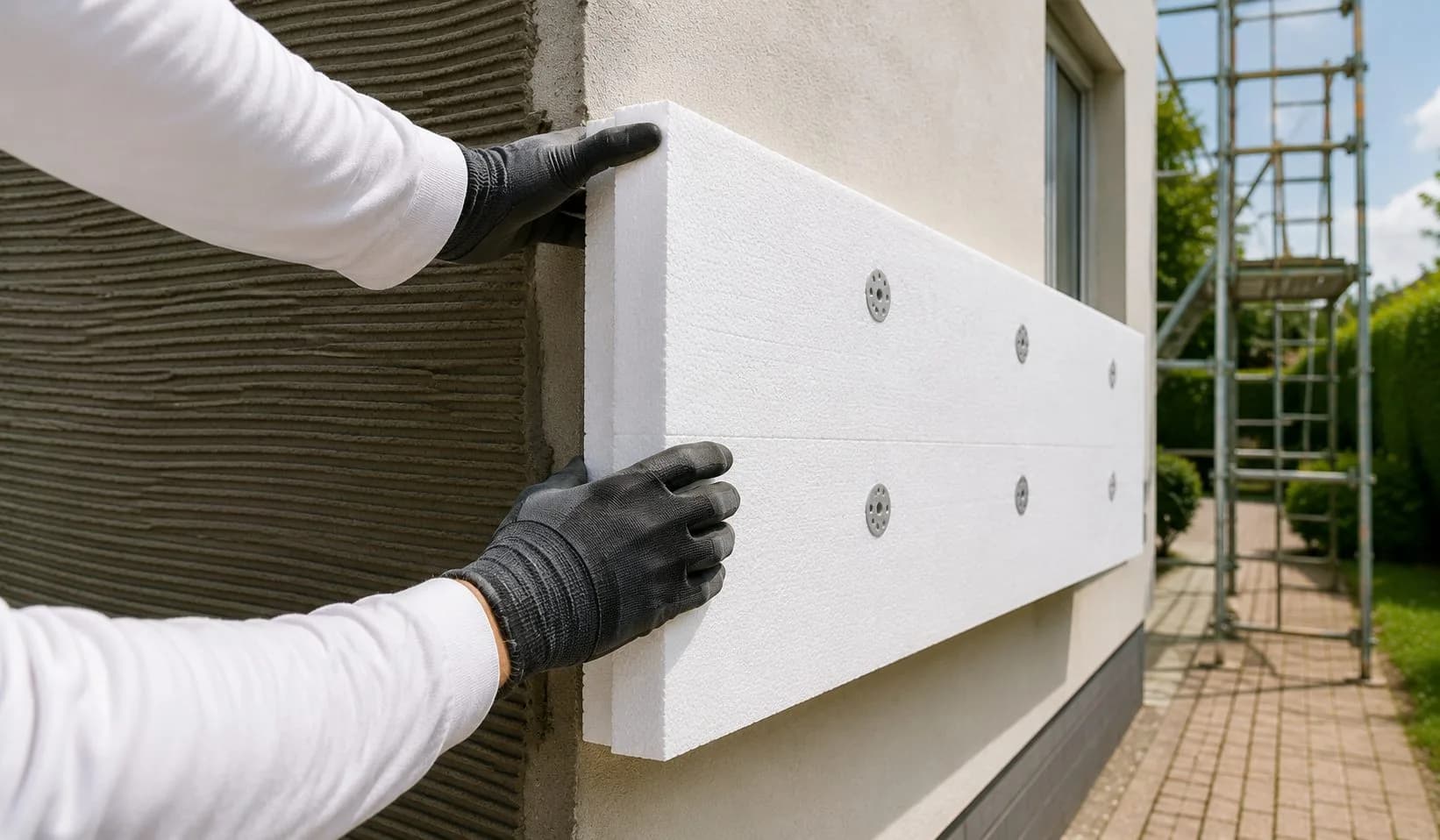
Government-backed grant funding for external wall insulation exists because solid-walled properties — particularly those built before 1920 — lose a disproportionate amount of heat through uninsulated walls, and the upfront cost of EWI is high enough that many households cannot self-fund the work. Grant schemes aim to close that gap, particularly for households in or at risk of fuel poverty. This guide explains the main routes to funding, who qualifies, and the important questions to ask before agreeing to anything.
Why the government funds EWI
The UK government has set legally binding targets to reduce carbon emissions and improve energy efficiency across the housing stock. Poorly insulated solid-walled homes — which represent a significant proportion of Yorkshire’s older terraced and semi-detached properties — are a priority because of the potential scale of improvement. EWI on a pre-1920s solid brick property can reduce wall heat loss by 35–45%, which contributes meaningfully to both household energy bills and national carbon targets.
Grant funding is directed primarily through two mechanisms: obligations placed on large energy companies to fund efficiency improvements for eligible households, and government-administered scheme funding for households meeting income and property criteria. The availability and terms of these schemes change as funding rounds open and close.
Important
The information in this guide reflects schemes that have been available in Yorkshire. Grant eligibility criteria, funding levels and availability change regularly. Always verify current availability directly with your energy supplier, the government’s official scheme portal, or your local council before making decisions based on potential grant funding.
ECO4: the main income-linked grant route
The Energy Company Obligation (ECO) is the primary government mechanism for delivering grant-funded energy efficiency measures to eligible households. Under ECO, large energy suppliers are legally obligated to fund improvements — including EWI — for households meeting the scheme criteria. ECO4 is the most recent iteration of this obligation.
ECO4 targets households in fuel poverty and those in the least energy-efficient properties. The key eligibility factors are:
- Benefit entitlement. Households receiving certain means-tested benefits — including Universal Credit, Pension Credit, Child Tax Credit, Housing Benefit and others — are eligible under the income pathway. The qualifying benefit list is set by government and should be verified against current guidance.
- EPC rating. The property generally needs an EPC rating of D, E, F or G. A solid-walled Victorian or Edwardian property with no existing insulation will almost certainly fall into this range.
- Wall construction. EWI under ECO4 is intended for solid-walled properties or those where the cavity cannot be filled. A survey determines whether the wall construction qualifies under the current scheme rules.
- Property type. The scheme primarily covers private homes. Eligibility for rented properties varies depending on landlord circumstances and the specific scheme rules in force.
If a household qualifies under ECO4, the energy supplier funds some or all of the EWI installation. Fully funded installations do exist under ECO, but partial funding requiring a homeowner contribution is also common. Contact your energy supplier directly or check the government’s official energy efficiency scheme portal to find out what you may qualify for.
The Great British Insulation Scheme
The Great British Insulation Scheme (GBIS) was designed to reach a broader set of households than ECO4 alone, targeting homes with an EPC rating of D or below across a wider income range. Unlike ECO4, which focuses primarily on benefit-receiving households, GBIS extended some eligibility to households not in receipt of qualifying benefits but living in lower-rated properties.
GBIS had two eligibility tracks:
- Group A (income-based). Households receiving certain means-tested benefits, broadly similar criteria to ECO4. Higher funding levels available under this track.
- Group B (EPC-based). Any household with an EPC rating of D, E, F or G, regardless of income, provided the property meets other scheme criteria. Funding levels under Group B are typically lower than the income track.
EWI is one of the measures eligible under GBIS for solid-walled properties. Check the current status of GBIS and any successor schemes directly with the government’s scheme information or your energy supplier, as programmes open and close on their own timelines.
Yorkshire council and local authority schemes
In addition to the national ECO and GBIS routes, Yorkshire’s local authorities occasionally run or facilitate their own home energy improvement schemes, often using government funding allocated at regional level. These can include:
- Council-administered Warm Homes schemes. Some Yorkshire councils administer area-based schemes where a group of homes in a specific street or neighbourhood are targeted for improvement together — common in Yorkshire’s older terraced housing areas.
- Warm Homes: Local Grant. The government has directed funding to local authorities specifically for improving the energy efficiency of off-gas-grid homes and homes of low-income households. Eligibility and availability varies by council area.
- Social housing programmes. Housing associations and local authority housing departments run improvement programmes for tenants, which can include EWI as part of EPC compliance targets.
For homeowners in Leeds, York, Bradford, Hull or elsewhere in Yorkshire, the starting point is contacting your local council’s housing or energy department directly to ask what is currently available. Council schemes are often not widely advertised — the most reliable way to find them is to ask.
‘Free EWI’ offers: what to watch for
Grant-funded EWI has created a market in which installers approach homeowners directly — by phone, door-knock or online advertising — offering “free external wall insulation” or “government-funded insulation.” Some of these offers are legitimate. Others are not. The presence of genuine grant schemes has also created cover for poor-quality work to be installed under official-sounding language.
If someone contacts you about free EWI, establish these facts clearly before agreeing to anything:
- Who is the installer?The company actually doing the work — not the intermediary who approached you. Ask for the installing company’s name and check their registration. TrustMark registration and manufacturer approved-installer status are relevant indicators.
- What is the full product specification? A legitimate installation will have a clear specification: board type, thickness, lambda value, basecoat and finish coat products. If no one can tell you what is going on your wall, that is a warning sign.
- What warranty does the installation carry? Grant-funded installations should carry a warranty backed by a recognised warranty provider. Ask for this in writing before agreeing to anything.
- What happens if there are problems? Who is responsible if the installation fails — the intermediary, the installer, or the funding body? This needs to be clear and in writing before work starts.
A note on quality
EWI is a complex installation that depends on correct specification and careful workmanship — particularly at junctions around windows, doors and at the eaves. The absence of an upfront cost does not mean the installation carries no risk. Ask as many questions about specification and quality as you would for a self-funded installation.
How to find and apply for EWI funding
There is no single application portal for all EWI grant schemes. The most reliable routes to finding what you may be eligible for:
- Contact your energy supplier directly. Large energy companies are obligated to deliver ECO measures. Your supplier is the starting point for finding out whether you qualify under the current obligation round.
- Check the government’s official portal. Search for “Great British Insulation Scheme” or “ECO4 scheme” on gov.uk for current information on eligibility and how to apply.
- Contact your local council.Yorkshire local authorities are delivery partners for some government-funded schemes. Your council’s housing or energy team can advise on what is currently available in your area.
- Check your EPC rating first.Your property’s EPC is a key eligibility factor for most schemes. Look it up on the government’s EPC register. If your EPC is out of date, a new assessment costs approximately £60–100 and is worth obtaining before exploring grant routes.
Sprayplast can survey your property and confirm whether it is technically suitable for EWI — information you may need when assessing grant eligibility. We do not administer grant applications, but we advise on the technical side honestly. Arrange a free survey here.
If you don't qualify for grant funding
Many Yorkshire homeowners with solid-walled properties will find they don’t qualify for available grant schemes — typically because household income is above the benefit threshold and the property’s EPC is already at D, despite having uninsulated walls.
For self-funding homeowners, the key considerations are:
- EWI as a combined investment. If the existing render is failing and needs replacing, EWI may cost only moderately more than a full re-render while delivering substantially more in thermal performance and longevity. Comparing EWI against the realistic alternative — re-render plus ongoing uninsulated walls — gives a more accurate picture than comparing against doing nothing.
- Staged work. Where budget is a constraint, starting with the most exposed elevations can provide meaningful improvement without completing the full envelope at once.
For a clear picture of costs and whether EWI makes financial sense for your property, see our EWI cost guide and our page on external wall insulation.