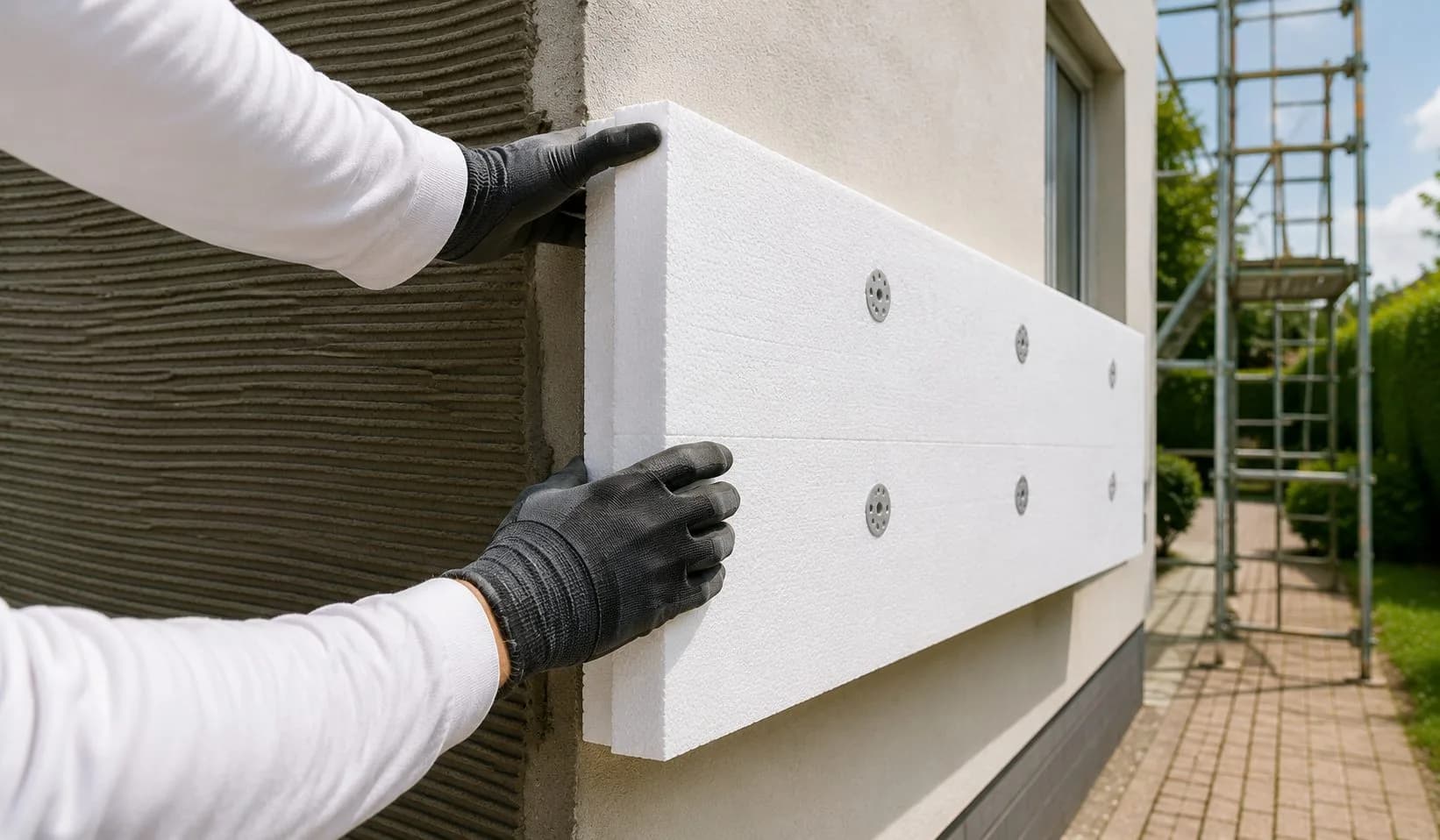
External wall insulation is a more complex installation than surface rendering — insulation boards, mechanical fixings, base coat with reinforcing mesh, primer and decorative finish, all applied precisely over the existing wall. The cost reflects that complexity, and the price range is wide because the main material cost driver — insulation thickness — can vary significantly depending on what thermal performance the installation is targeting.
What determines EWI cost
Five factors primarily determine the installed cost of an EWI system:
- Wall area. The m² of external wall being insulated is the primary cost driver. For a typical two-storey semi in Yorkshire, external wall area to be treated typically falls between 70–100m².
- Insulation thickness. 50mm, 100mm and 150mm insulation boards have progressively higher material costs and, at greater thicknesses, affect details around windows and doors significantly. Thickness is driven by what U-value target is being aimed for.
- Insulation type. Expanded polystyrene (EPS) is the most common and most cost-effective. Mineral wool is more expensive but is non-combustible and sometimes specified on taller buildings or in certain planning contexts.
- Finish system. Silicone render finish is standard. Monocouche, brick-slip or other finishes add cost.
- Substrate condition and access. A wall with significant existing render to strip, or poor masonry condition, adds to the pre-installation preparation cost. Scaffolding cost increases with building height and complexity.
EWI price ranges in Yorkshire
The following indicative ranges are for fully installed EWI systems in Yorkshire, including scaffolding, all components and VAT. Significant preparatory repair work, unusual access or non-standard finishes will move prices higher.
| Specification | Per m² | Typical 3-bed semi |
|---|---|---|
| EPS, 50mm, silicone finish | £100 – £140 | £8,000 – £17,000 |
| EPS, 100mm, silicone finish | £110 – £155 | £9,000 – £19,000 |
| Mineral wool, 100mm, silicone finish | £110 – £150 | £13,000 – £21,000 |
Guide prices only. All prices include materials and installation. Final quotations depend on property size, condition, access requirements and scaffolding. Major repairs, pebbledash removal and non-standard access are quoted separately.
What a proper EWI quotation should include
An EWI installation has more components than surface rendering, and a proper quotation should itemise all of them. If any of these are absent from a quote, ask why:
- Existing render or substrate preparation, including stripping if required
- Starter track at base of wall
- Adhesive and mechanical fixing of insulation boards
- Insulation specification: product, thickness, thermal conductivity (lambda value)
- Base coat with alkali-resistant reinforcing mesh
- Corner beads, movement joints and window/door reveals
- Primer coat
- Decorative finish coat with product and colour reference
- Scaffold supply and removal
- Waste clearance
- U-value target and calculation confirmation
- Warranty details — workmanship and any manufacturer-backed system warranty
Realistic energy savings from EWI
The energy saving delivered by EWI depends on the property, the existing wall construction, the heating system and how the property is occupied. Heat loss through walls is one component of total heat loss — a house also loses heat through the roof, floor, windows and ventilation — and EWI reduces only the wall element.
For a solid-wall property where the walls are the dominant source of heat loss — common in Victorian and Edwardian terraces with no cavity — EWI makes a meaningful difference to heating demand. For a well-insulated modern house where wall loss is already low, the saving is smaller. An honest installer will give you a realistic assessment of what improvement is likely for your specific property, not a marketing headline that assumes ideal conditions.
Grants and funding for EWI
Government-backed grant funding for EWI exists through schemes such as ECO4 (Energy Company Obligation), which requires energy companies to fund energy efficiency improvements for eligible households. Eligibility criteria are complex — they depend on household income, benefit entitlement, property EPC rating and other factors — and the availability of funding through specific schemes changes regularly.
We do not administer grant applications, but we can confirm whether a property is technically suitable for EWI if you are pursuing funding through an energy company or a council-run scheme. If someone is offering you “free EWI” through a cold call, establish clearly who is funding the work, what products will be used, what the specification is, and what happens if problems arise — before agreeing to anything.
Comparing EWI quotations
When comparing EWI quotations, the specification is the most important variable — not the headline price. Two quotations both described as “EWI” at different prices are often specifying materially different things: different insulation thicknesses, different board products with different thermal conductivity values, different mesh weights in the base coat. These differences affect both cost and long-term performance.
Ask for the U-value target the installation is designed to achieve, and ask for confirmation that the specification will meet it. A contractor who cannot tell you the U-value they are targeting is not specifying EWI professionally.
These standards apply whether you are commissioning EWI in York, Hull, Doncaster or anywhere else across Yorkshire — specification criteria are the same regardless of location.