
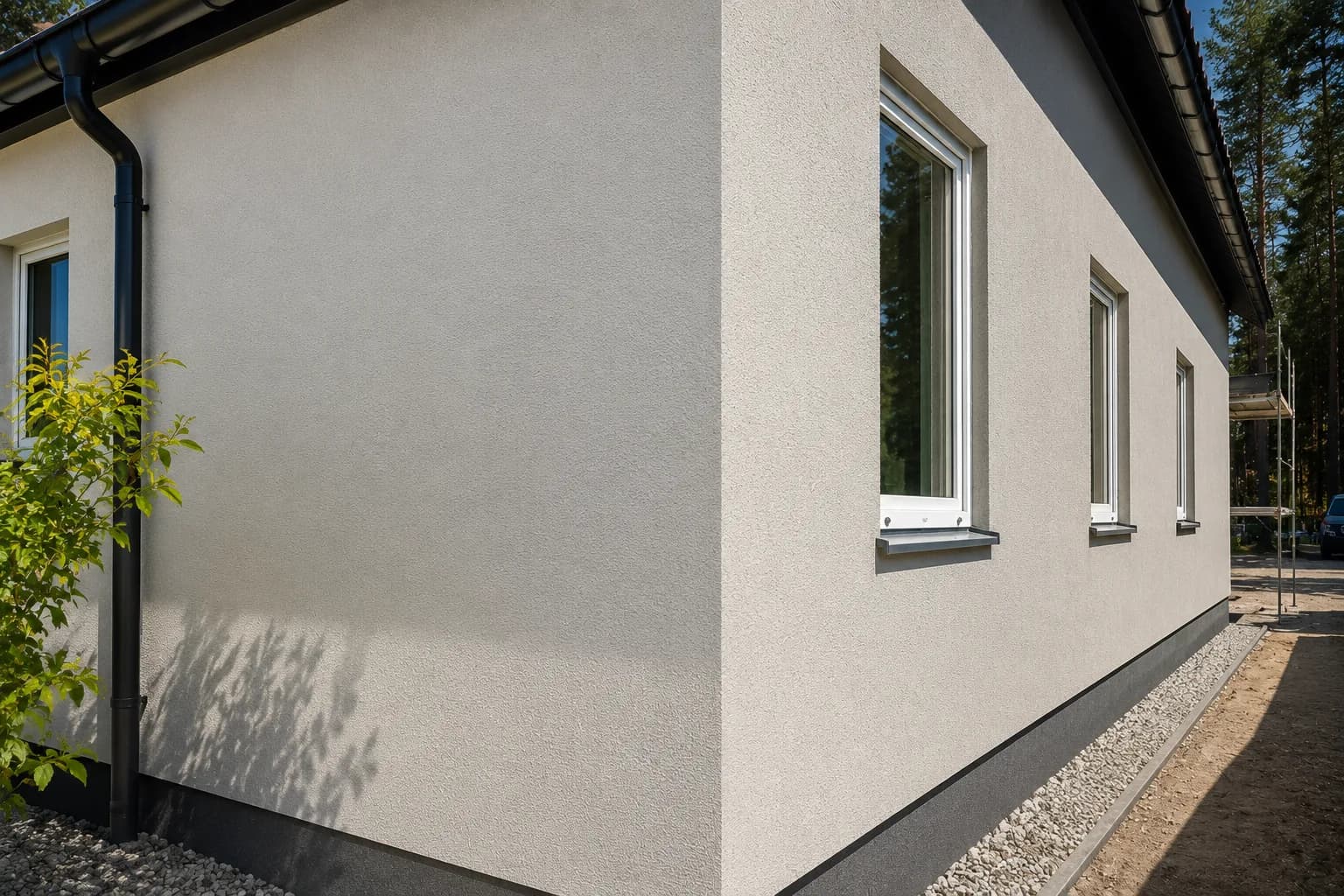
Monocouche Render
A factory-mixed mineral render applied in a single coat and scraped back while fresh to reveal a through-coloured, textured finish — the traditional choice for period properties, conservation areas, and homes where a natural stone or aggregate character is the right specification.
Real benefits for your home — not just features on a spec sheet
No painting — ever
The colour is integral to the mortar mix, not applied as a surface film. There is no repainting cycle to budget for, and no coating to peel, blister or fade with UV exposure over time.
Authentic mineral character
The scrape-back process reveals the aggregate in the mix, producing a textural depth and mineral quality that suits period properties and Yorkshire's stone vernacular far more naturally than a smooth polymer topcoat.
Genuinely breathable
Monocouche is a cementitious render with no polymer film on the surface. It is highly vapour-permeable, allowing moisture in older solid-walled properties to escape through the render rather than being trapped behind it.
Three scrape textures, all through-coloured
Fine, medium and coarse scraped finishes give you control over the level of texture and aggregate exposure — from a subtly textured surface to a more pronounced, stone-like character. Colour is consistent throughout the render.
Acceptable in most conservation areas
Where planning guidance requires a mineral or cementitious render rather than a synthetic topcoat, monocouche is typically appropriate. Always confirm with your local planning authority before proceeding, particularly for listed buildings.
How we deliver it
A clear, considered process from first survey to final sign-off — no surprises along the way.
- 01
Survey & substrate assessment
We assess the existing wall for soundness, adhesion and moisture. Monocouche bonds directly to masonry or existing render — substrate condition determines whether repairs or additional primer are required before application.
- 02
Repairs & preparation
Defects, cracks and loose material are addressed, surfaces cleaned, and bead positions confirmed and fixed. Correct preparation is particularly important with monocouche because there is no separate base coat to level minor substrate inconsistencies.
- 03
Primer application
A manufacturer-specified cementitious primer is applied to regulate surface suction across the elevation, ensuring the monocouche mortar achieves even adhesion and cures consistently across different substrate types and porosities.
- 04
Single-coat application
The factory-mixed monocouche mortar is applied to the full specified thickness in a single pass by machine or hand float. Unlike multi-coat systems, the entire build-up goes on in one operation to the required depth.
- 05
Scraping back & final inspection
Once the mortar reaches the right stage of green hardness — firm but still workable — it is scraped back with a straight edge or serrated tool to reveal the aggregate and achieve the chosen texture. A final inspection confirms coverage, edge detail and consistency before scaffolding is removed.
What's included
Every layer of the system is specified for performance, not just appearance.
Factory-mixed monocouche mortar
Pre-batched at the factory for consistent colour, aggregate distribution, workability and performance — eliminating the on-site mixing variables that cause colour variation and finish inconsistency in hand-mixed systems.
Aggregate scrape finish
The aggregate within the mortar mix is revealed by the scrape-back process, giving monocouche its characteristic textural depth and mineral quality. Grain size in the mix determines the texture level: fine, medium or coarse.
Cementitious primer
Applied to the prepared substrate to regulate suction and improve adhesion. The primer is system-specified to be compatible with the monocouche mortar — mixing products from different manufacturers is not recommended and may affect adhesion and warranty validity.
Stainless steel beading
Corner, stop and movement beads in stainless steel for clean, durable lines at all junctions and reveals — longer-lasting than PVC equivalents in Yorkshire's exposed conditions.
Through-colour throughout
Because the colour is integral to the mortar rather than painted on, monocouche never needs repainting and is not susceptible to surface peeling or delamination — a significant practical advantage over painted finishes and protective coating systems.
Manufacturer-Backed Warranty
Installed to manufacturer specification, monocouche carries the manufacturer's product guarantee where applicable, backed by our own workmanship guarantee on every installation. If the result doesn't meet the standard we agreed, we come back and put it right.
Request your free quoteCommon questions
What is the difference between monocouche render and silicone render?
The key differences are material composition, application method and finish character. Monocouche is a cementitious render applied in a single thick coat and scraped back to reveal the aggregate — it produces a mineral, textured appearance with high breathability. Silicone render is a polymer-modified system with a silicone topcoat applied over a reinforced base coat — it is smoother, more hydrophobic (water-repellent), self-cleaning, and available in a wider colour range. Monocouche is typically better suited to period properties and conservation areas where a traditional mineral aesthetic is the right specification. Where maximum water repellency and a self-cleaning surface are the priority, silicone render is usually the better choice.
What texture finishes are available in monocouche?
Monocouche is available in fine, medium and coarse scraped finishes. A fine scrape produces a relatively smooth surface with subtle aggregate texture. A medium scrape gives a more pronounced finish with visible aggregate. A coarse scrape reveals significantly more aggregate and produces a rustic, stone-like character. The exact texture options vary slightly between manufacturers — we bring samples to the survey so you can compare finishes against your property and choose in context.
How long does monocouche render last?
A well-specified and correctly applied monocouche system typically performs well for 20 to 25 years in normal UK conditions. Longevity depends on substrate preparation quality, primer compatibility, render specification and the exposure level of the elevation. Because there is no polymer surface film to delaminate, monocouche tends to weather gradually rather than failing suddenly — an advantage on period properties where slow, even weathering is more sympathetic than a sharp new surface.
Is monocouche render acceptable in a conservation area?
In most cases yes — monocouche is a cementitious mineral render that is generally considered appropriate where traditional render materials are required. However, planning requirements vary between local authorities and individual properties, particularly for listed buildings where the planning authority may specify the exact material, colour or texture. We advise checking directly with your local planning authority before committing to a specification, and can advise during the free survey on what is typically acceptable in your area.
Can monocouche render be applied over existing render?
In some cases yes, provided the existing render is sound, well-bonded and compatible with monocouche. Where the existing render is loose, blown, cracked, excessively thick or incompatible, removal before the new system is applied will give a better, longer-lasting result. We assess substrate condition during the free survey and give an honest recommendation — if overcladding is appropriate, we'll confirm it; if removal is the right call, we'll say so and explain why.
What colour range is available for monocouche render?
Monocouche is available in fewer standard colours than silicone render — typically 30 to 60 shades per manufacturer, covering stone, sand, cream, buff and grey tones as well as heritage colours suited to period properties. Because the colour is integral to the mortar mix rather than applied as a topcoat, bespoke colour matching is less straightforward than with silicone. We work with manufacturers including K-Rend and Weber, and bring colour samples to the survey so you can compare against your property and its context.
Useful guides for monocouche render
Monocouche Render across Yorkshire
We cover towns and cities across Yorkshire — follow the links below for area-specific information including local housing types, planning considerations and what to expect from your survey.
Ready to transform your property?
Get a free, no-obligation quote from Yorkshire's premium rendering and insulation specialists. We typically reply within one working day.