
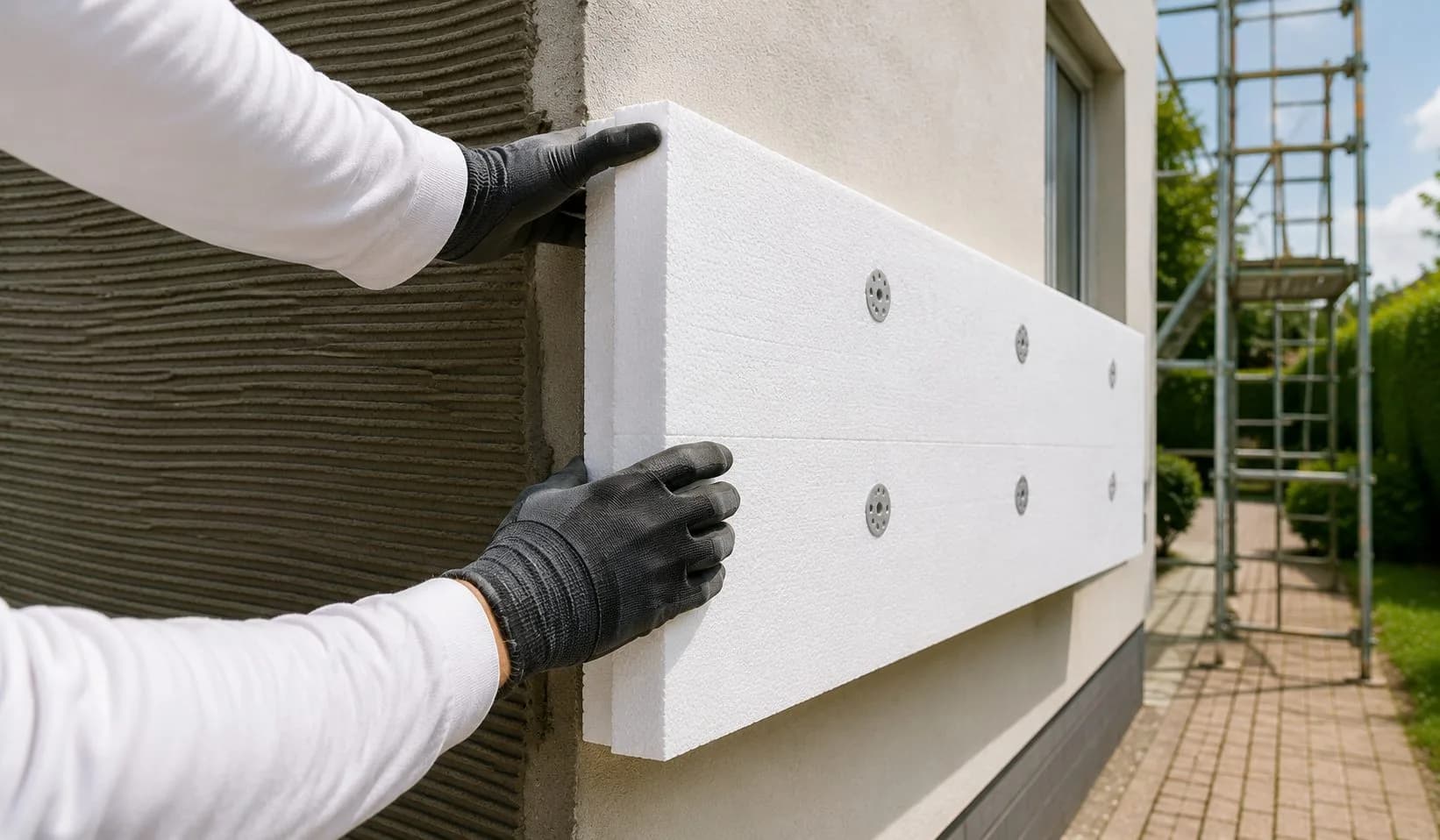
If you want to insulate the external walls of your home, you are likely to be told to consider either external wall insulation (EWI) or cavity wall insulation (CWI). They address the same problem — heat loss through external walls — but in very different ways, and one or the other will be appropriate for your property depending on how it is built. This guide explains the difference clearly.
How each system works
Cavity wall insulation fills the empty cavity between the two leaves of a cavity wall — the inner block leaf and outer brick skin — with insulation material, typically mineral wool, expanded polystyrene beads or polyurethane foam. The cavity, which normally contains only air, becomes an insulated barrier. The process involves drilling holes in the outer leaf, injecting or blowing insulation into the cavity, and plugging the holes. The external appearance of the property is unchanged.
External wall insulation adds a layer of insulation board — expanded polystyrene, mineral wool or phenolic foam — to the outside of the wall, which is then finished with a reinforced render system. The insulation is fixed mechanically and with adhesive to the external wall surface, regardless of the wall construction beneath. It works on solid walls as well as cavity walls, and significantly increases the U-value of the wall assembly.
Which properties can use each system
Cavity wall insulation requires a cavity to fill. Properties built before approximately 1920 in the UK are almost entirely solid-walled — one leaf of brick or stone construction without any gap. These properties cannot have cavity wall insulation. Cavity construction became widespread from the 1920s onwards; most properties built between 1930 and 1995 have unfilled cavities suitable for CWI. Properties built after the mid-1990s often already have cavities filled with insulation board at the time of construction.
EWI can be applied to virtually any wall construction — solid masonry, brick cavity, stone, concrete blockwork, or timber frame. It is not constrained by what is behind the external wall. This makes it particularly relevant for solid-walled properties built before 1920, which make up a significant proportion of Yorkshire's older housing stock — the Victorian and Edwardian terraces of Bradford and Hull are particularly typical of this construction type.
Cost comparison
The cost difference between the two options is substantial:
| System | Typical cost (3-bed semi) | Disruption |
|---|---|---|
| Cavity wall insulation | £400 – £1,500 | Half-day installation, no scaffold |
| External wall insulation | £8,000 – £19,000+ | 1–3 weeks, scaffolding required |
CWI is significantly cheaper because the work is straightforward and fast. EWI costs more because it involves substantially more materials, more labour, scaffolding and the complete new render system on the outside of the building.
Government grants — including the ECO4 scheme and Great British Insulation Scheme — are available for both measures in eligible households. Eligibility criteria change regularly; the most reliable way to check current availability is via the Energy Saving Trust or your local council.
Performance: how much heat do they save?
Both measures address the same problem — heat loss through external walls — but their performance differs significantly depending on the starting point.
For a typical solid-walled Victorian property (U-value circa 2.1 W/m²K), EWI with 100mm EPS insulation can reduce the wall U-value to approximately 0.3 W/m²K — a reduction of around 85%. For a cavity wall property with an unfilled cavity (U-value circa 1.6 W/m²K), cavity wall insulation typically achieves a wall U-value of circa 0.45 W/m²K — a reduction of around 70%.
In both cases, the improvement is meaningful and typically reduces heating bills by a measurable amount. EWI generally delivers a larger absolute improvement in thermal performance, which is part of why it costs more.
How to decide
- If your property is solid-walled: EWI is your only external wall insulation option. Cavity wall insulation is not possible where there is no cavity.
- If your property has a cavity: CWI is the simpler and cheaper option if the cavity is suitable. EWI is an alternative if you also need to replace the external render, if the existing render is failing, or if you want a more substantial thermal improvement than CWI alone can deliver.
- If you need a new render anyway: The additional cost of upgrading to EWI rather than just re-rendering is often relatively modest, because the scaffold and labour are already committed. EWI in this context can be good value.
For more on EWI costs and what to expect from a project, see our EWI cost guide.