
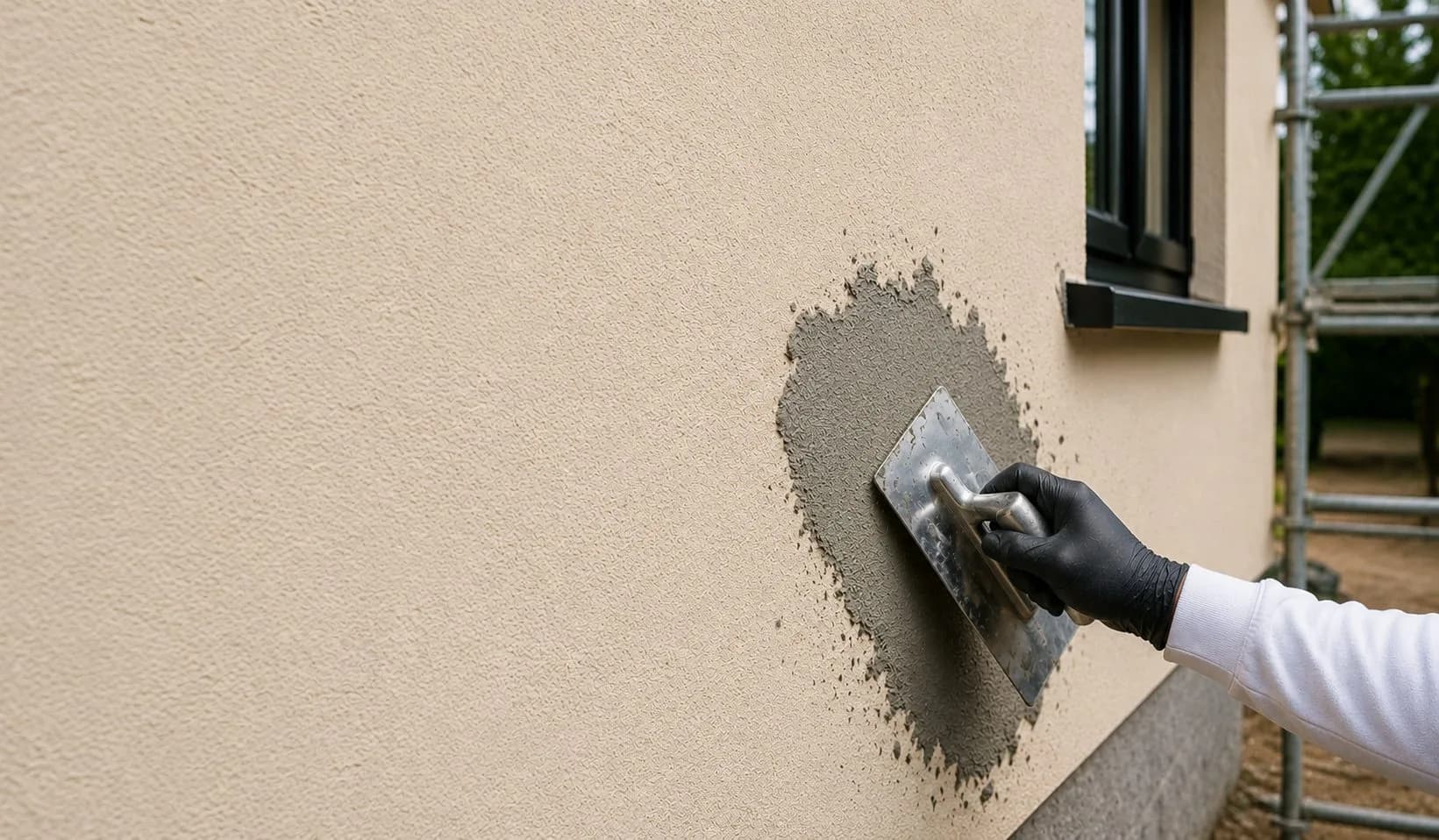
When render starts to fail, the question of whether to repair or replace the whole system is one of the most common decisions homeowners face — and one where it is easy to be guided toward unnecessary expenditure. This guide explains the factors that genuinely determine the right answer.
When repair is the right answer
Repair is the appropriate solution when the failure is localised — affecting a specific area rather than the render system as a whole — and when the bulk of the existing render is sound and well-bonded to the substrate.
Repair typically makes sense in the following situations:
- Single blown or detached section. A section of render that has debonded from the substrate in one area, with the surrounding render remaining sound, is a candidate for localised removal and patching. The key test is the tap test — sections that sound hollow when tapped have lost adhesion to the substrate; sound sections ring differently.
- Cracks around openings. Cracking at corners of windows and doors is common and often caused by differential movement between the render and the frame rather than systemic render failure. These can usually be repaired with appropriate flexible sealant or filler without replacing the surrounding render.
- Impact damage. A section damaged by an external impact — a falling object, a vehicle, a ladder — where the surrounding render is intact can be repaired directly without wholesale replacement.
When full replacement is the right answer
Full replacement becomes the more cost-effective option when the extent of failure reaches a tipping point — typically when the failing area represents more than around 30–40% of the total render surface, or when the substrate condition makes successful repair doubtful.
Full replacement is usually the right answer when:
- The tap test reveals widespread hollow areas. If tapping the render surface reveals hollow-sounding sections across a large proportion of the wall, the render has lost adhesion to the substrate over a wide area. Patching individual hollow sections while leaving the rest in place typically results in further areas failing over the following seasons.
- The system has reached the end of its serviceable life. Render that is significantly aged — pebbledash from the 1960s or 70s, for example — may have residual adhesion but little remaining flexibility or weather resistance. Patching and repainting can extend its visual life for a few years, but the underlying system is degraded and will require replacement eventually. The question becomes whether to spend on repeated short-term patches or invest in a new system that will perform for another 25 years.
- The substrate is damaged. Where render failure has allowed moisture to reach the underlying masonry — causing spalling, efflorescence, or deterioration of the substrate — the damaged substrate must be repaired and stabilised before any new render is applied. This scope of work is often comparable to the cost of a full replacement.
- Colour or texture matching is impossible. On older render systems, particularly pebbledash, matching the colour and texture of existing render precisely enough that repairs are invisible is often not achievable. A patch repair on a 30-year-old pebbledash will always be visible. Full replacement gives you a consistent, uniform finish.
The cost calculation: repair versus replace
The financial comparison depends heavily on how much repair is required relative to the total wall area. A useful rule of thumb:
- When failing areas are under 20% of the wall: repair is almost always cheaper and makes sense.
- When failing areas are 20–40% of the wall: the comparison is closer. Factor in how long the remaining render is likely to last — if it is clearly approaching end of life, repeated repairs may cost more than a replacement over a five-year horizon.
- When failing areas exceed 40% of the wall: full replacement is typically more cost-effective, avoids the aesthetic problem of visible patches, and provides a new system warranty.
These are rough guidelines. The specific substrate condition, the age of the existing render and the quality of the original installation all affect the calculation. An honest assessment from an experienced contractor during a survey is the most reliable way to make this decision.
How to avoid being pushed into unnecessary work
The render repair versus replacement decision is one where homeowners can be unnecessarily guided towards a full replacement. Some things to watch for:
- Ask for the tap test to be explained. A contractor who recommends full replacement should be able to show you where the render is hollow and explain what proportion of the surface area this represents. If they cannot, or will not, that is a warning sign.
- Get a second opinion on significant work. For a decision involving several thousand pounds, a second survey costs little and is worthwhile. Two contractors who independently reach the same conclusion give you reasonable confidence.
- Ask specifically about repair options. If a contractor only quotes for full replacement without offering a repair option, ask them directly whether repair is possible and what the difference in cost and life expectancy would be. A reputable contractor will give you an honest answer rather than selling you the most expensive option by default.
At Sprayplast, we serve homeowners across Yorkshire — including Bradford, Leeds and Doncaster — and will always tell you if repair is the more appropriate option for your property. We do not recommend full replacement where targeted repair is genuinely the right answer. Arrange a free survey here.